The oldest mule in the western Mediterranean. The case of the Early Iron Age in Hort d'en Grimau (Penedès, Barcelona, Spain)
Autores:
Silvia Albizuri,
Jordi Nadal,
Maria Martín Cuervo,
Aurora Grandal-D’Anglade,
Ludovic Orlando,
Antoine Fages,
Oriol Mercadal,
Josep Mestre,
Jordi Farré,
Javier López Cachero
Link: https://www.sciencedirect.com/science/article/pii/S2352409X25005395
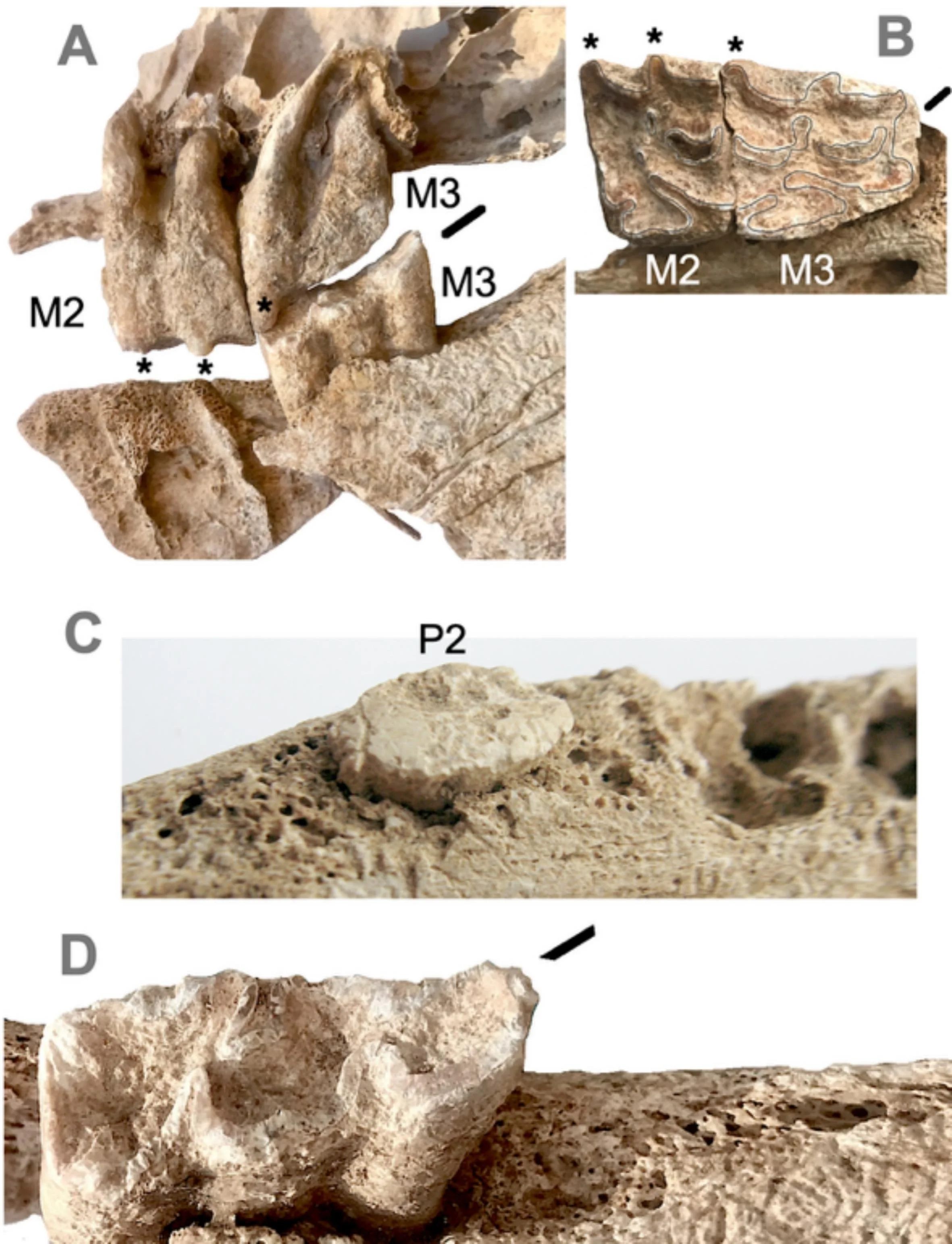
Anatomical position of the maxillary molars M2 and M3 in occlusion shows buccal enamel overgrowths and very sharp cusps (*) and mandibular molar M3 with differentiated hook (−). B: occlusal drawing of maxillary M2 and M3. C: Detail of the anterior portion of the crown of the right mandibular P2. D: Detail of the posterior hook in M3 of the left mandible and concave occlusal wear.
Mules, first generation hybrids between a horse mare (Equus caballus) and a donkey jack (Equus asinus), are rarely documented in the western Mediterranean prior to Roman times. They may have been bred earlier in the Iberian Peninsula where domestic horses and donkeys had coexisted for at least a millennium. In this study, we use ancient DNA to identify a female mule from Hort d’en Grimau, an archaeological site located in the Prelitoral of the northeastern Iberian Peninsula dated to the First Iron Age (8th-6th century BCE). The animal was small in size and found in anatomical connection with the partially burnt remains of a woman, deposited inside a silo. Zooarchaeological analysis confirmed that the equid skeleton belonged to an adult-senile female exhibiting both horse and donkey morphological traits, with maxillary and mandibular pathologies consistent with riding. Stable carbon and nitrogen isotope analyses suggest a diet rich in cultivated cereals. This individual represents the earliest genetically confirmed mule in western Europe. Further research is needed to determine whether it was bred locally or introduced via Phoenician exchange networks.
Palabras clave: Mules, Iberia, Early Iron Age, Phoenician, Ancient DNA