New insights into the chronology of the Les Ferreres Aqueduct (Tarragona, Spain) by combining petrographic analyses and OSL dating on lime mortars
Autores:
Jorge Sanjurjo-Sánchez,
Nuria Guasch-Ferré,
Africa Pitarch Martí,
Marta Badia,
Joan Menchon,
Lluis Casas,
Jose Luis Prada
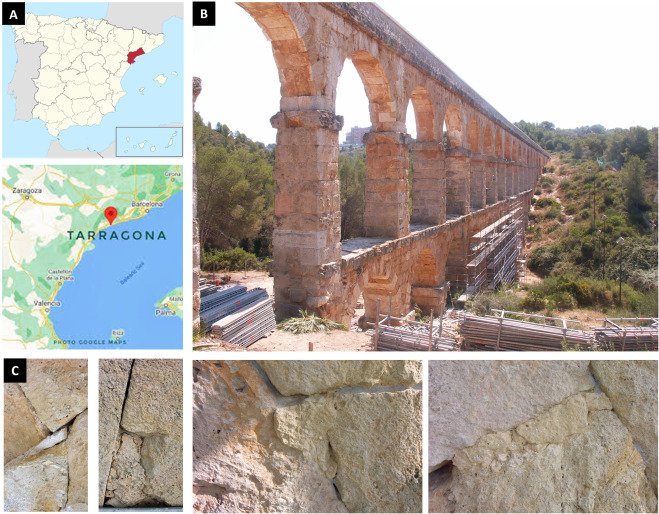
Geographical location of Tarragona; (B) Picture of Les Ferreres Aqueduct or Pont del Diable; (C) Close-up view of joint mortars.
Resumen:
The Les Ferreres bridge is a Roman aqueduct located in the municipality of Tarragona, Spain. It was constructed to supply water from the Francolí River to the ancient city of Tarraco. This aqueduct stands out as one of the most monumental and well-preserved examples from Roman times, and was listed as a UNESCO's World Heritage Site in 2000. From 2010 to 2015, a comprehensive restoration project was undertaken, funded by the Spanish Ministry of Public Works and the Tarragona City Council. The initiative involved conservation issues, cleaning of the monument, investigating the origin of the raw materials used to build it, and determining the construction age. The characterisation of the mortars allowed us to know, for the first time, that several types of mortars were used during the construction of the bridge, clearly different to other ones used in historical repairs. In this study, a comprehensive analysis of these mortars provides key information for the use of optical stimulated luminescence (OSL) in their dating, to provide insights into the construction phases and historical development of the aqueduct. Despite the heterogeneity of the mortar components, which added complexity to the dating process, the obtained OSL ages aligns with the historical and archaeological studies, providing new data about the chronology with unknown repairs during the Late Roman period.
Palabras clave: Mortar characterization, OSL dating mortar, POM analysis, Tarragona aqueduct, Roman engineering