Quaternary tectonic shortening and uplift of the Peruvian forearc due to subduction of the Nazca Ridge
Autores:
Luis Ayala-Carazas,
Willem Viveen,
Patrice Baby,
Rodrigo Uribe-Ventura,
Steven A. Binnie,
Jorge Sanjurjo-Sánchez,
César Beltrán-Castañon
Resumen:
The Nazca Ridge subduction beneath the Peruvian forearc presents a unique setting to evaluate the interplay between buoyant ridge subduction and continental forearc deformation. The current understanding of forearc deformation is largely based on numerical models with limited, field-based input data from small areas. This paper therefore presents a reconstruction of tectonic deformation in this region based on two topographic profiles across the entire continental forearc. The forearc overlying the ridge crest and leading edge hosts the large Quaternary Nazca Peneplain (QNP), which has registered uplift and deformation since the onset of ridge subduction. We developed a Conditional Variational Autoencoder (CVAE) deep learning model to reconstruct the QNP to its pre-eroded state and used this surface as input for two retrodeformed topographic profiles. The QNP and adjacent marine terraces were then dated using cosmogenic nuclide exposure and luminescence methods and used to calculate deformation rates. Forearc deformation involves uplift primarily due to folding, with basal thrusting or buoyancy of the Nazca Ridge acting as secondary drivers. Shortening rates since 1.85 ± 0.18 Ma to the present range from 0.32 to 0.36 mm a-1, and surface uplift rates up to 0.37 mm a-1. The 1.85 ± 0.18 Ma age combined with a regional bounding surface between shallow marine and fluvial gravels, provides an estimate for the timing of Nazca Ridge-overriding plate coupling. These results align with, and refine, previous numerical predictions on forearc deformation due to buoyant ridge subduction and offer a high-resolution dataset for future studies.
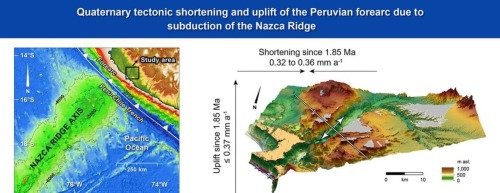
Graphical abstract
Palabras clave: Nuclide exposure dating, Artificial intelligence, Luminescence, Marine terraces, Nazca peneplain, Andes